Municipalities are Modernizing
Infrastructure Asset Management
What comes next?
The plan is written. The policy is approved.
Stronghill evaluates whether your asset management program is ready for, what comes next
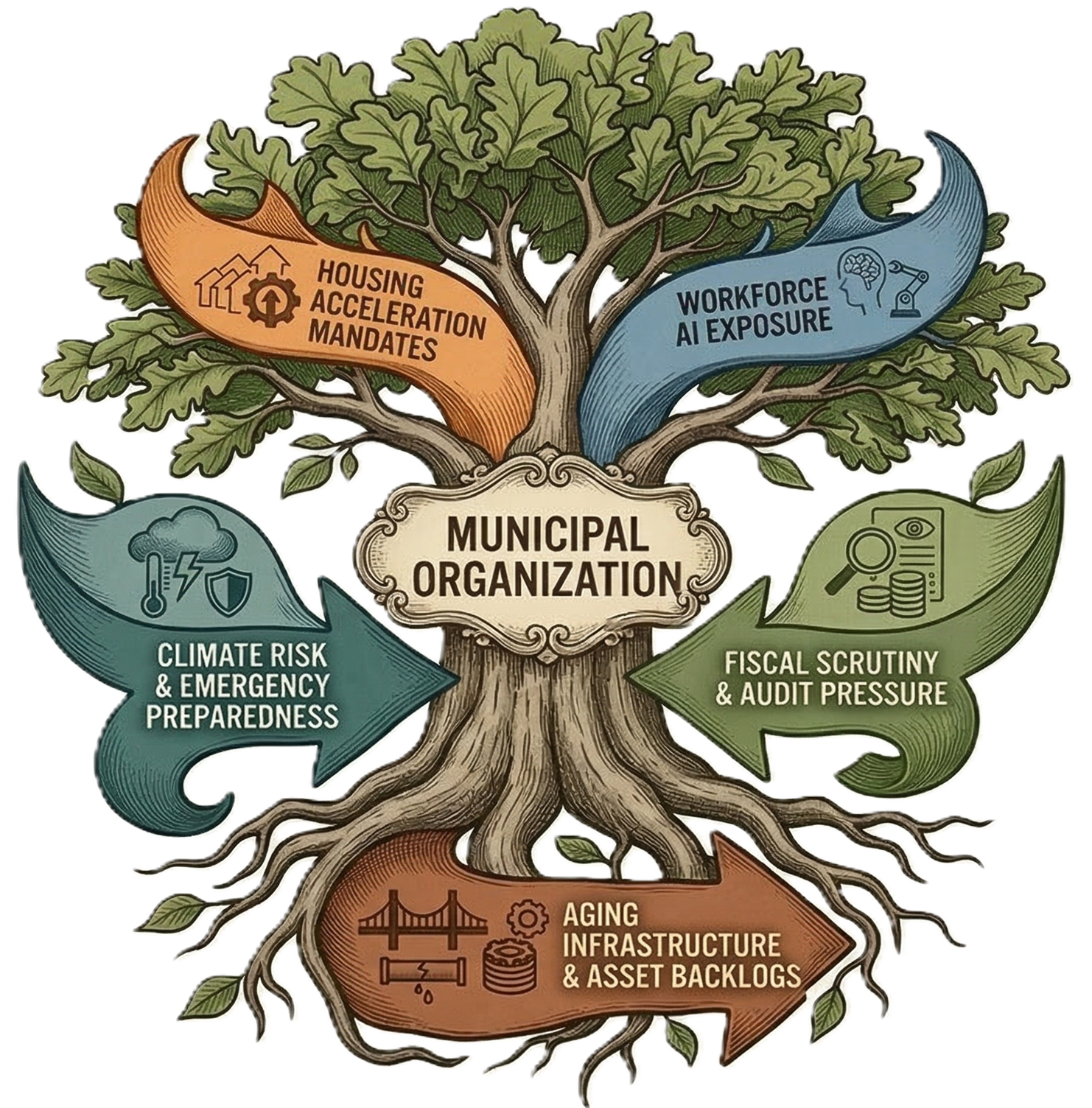
The Pressure Points
These pressures are not arriving one at a time. They are converging — on organizations whose asset management programs were built to meet compliance, not to perform under this kind of demand.
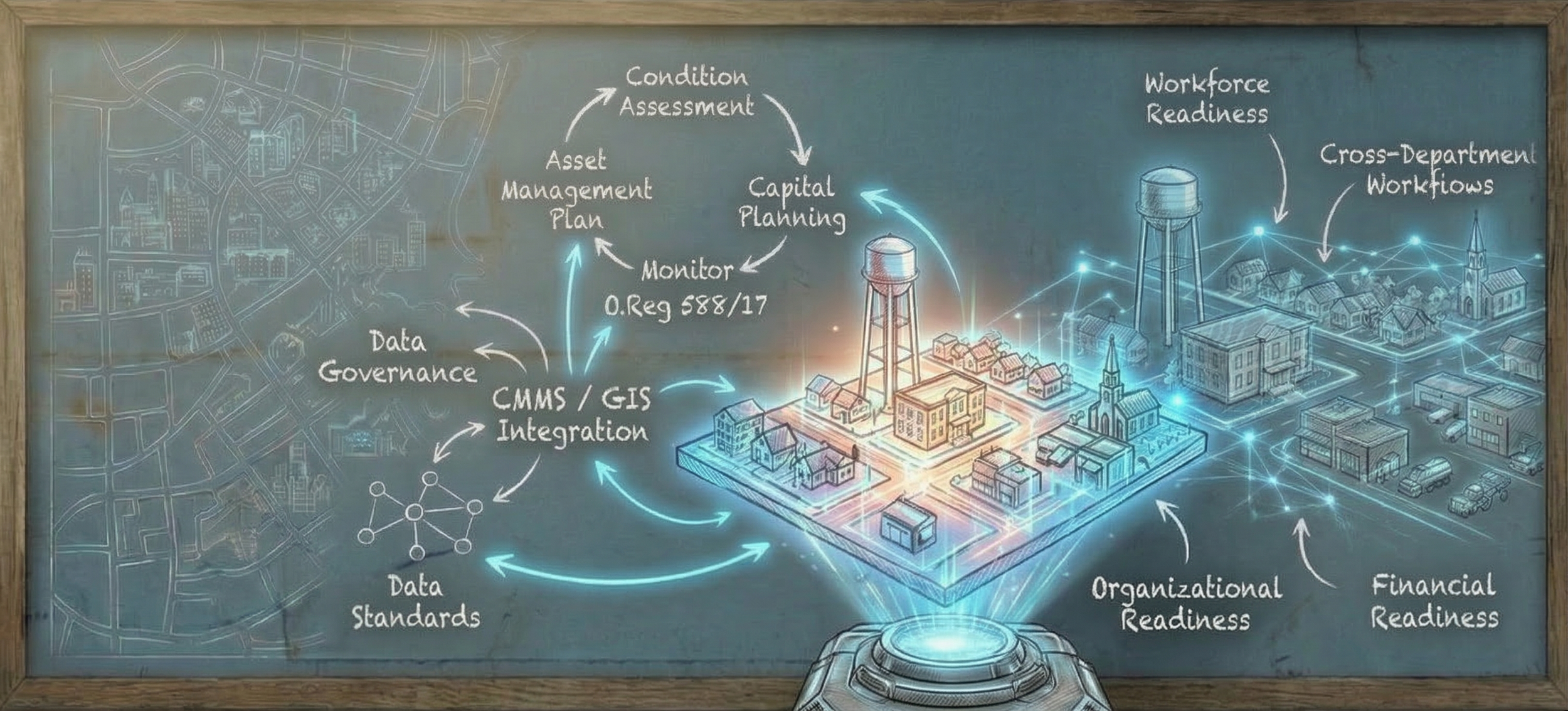
Your asset management plan needs your systems to be integrated. Your Monday morning says otherwise. GIS in one department. CMMS in another. Finance in a third. Three systems, three update cycles, three versions of the truth — connected by workarounds and data dumps.
The plan got you through compliance. What’s coming next requires a system.
THE FALSE FINISH LINE
Canada's asset management sector has done remarkable work over the past decade. Municipalities have built inventories, written plans, and formalized what had been informal for generations. In Ontario, O. Reg. 588/17 pushed 444 municipalities through an ambitious compliance cycle — approved plans for all assets, levels of service frameworks, and lifecycle strategies.
The next phase will not ask whether you have an asset management plan. It will ask whether your systems can prove it.
One System, Not Three
The upstream challenges — the siloed planning process, the legacy handoffs, the data that arrives late or not at all — are real. But trying to fix everything at once fixes nothing.
The Asset Registry is where we focus. Not as a collection of programs, but as one system:
GIS (where it is),
CMMS (what happened to it),
Finance (what it costs).
When those three function as an ecosystem, the cracks in everything upstream become visible — the delayed data, the locked PDFs, the handoffs that nobody owns. When they don't, the problems just blend into the background noise of how things have always been done.
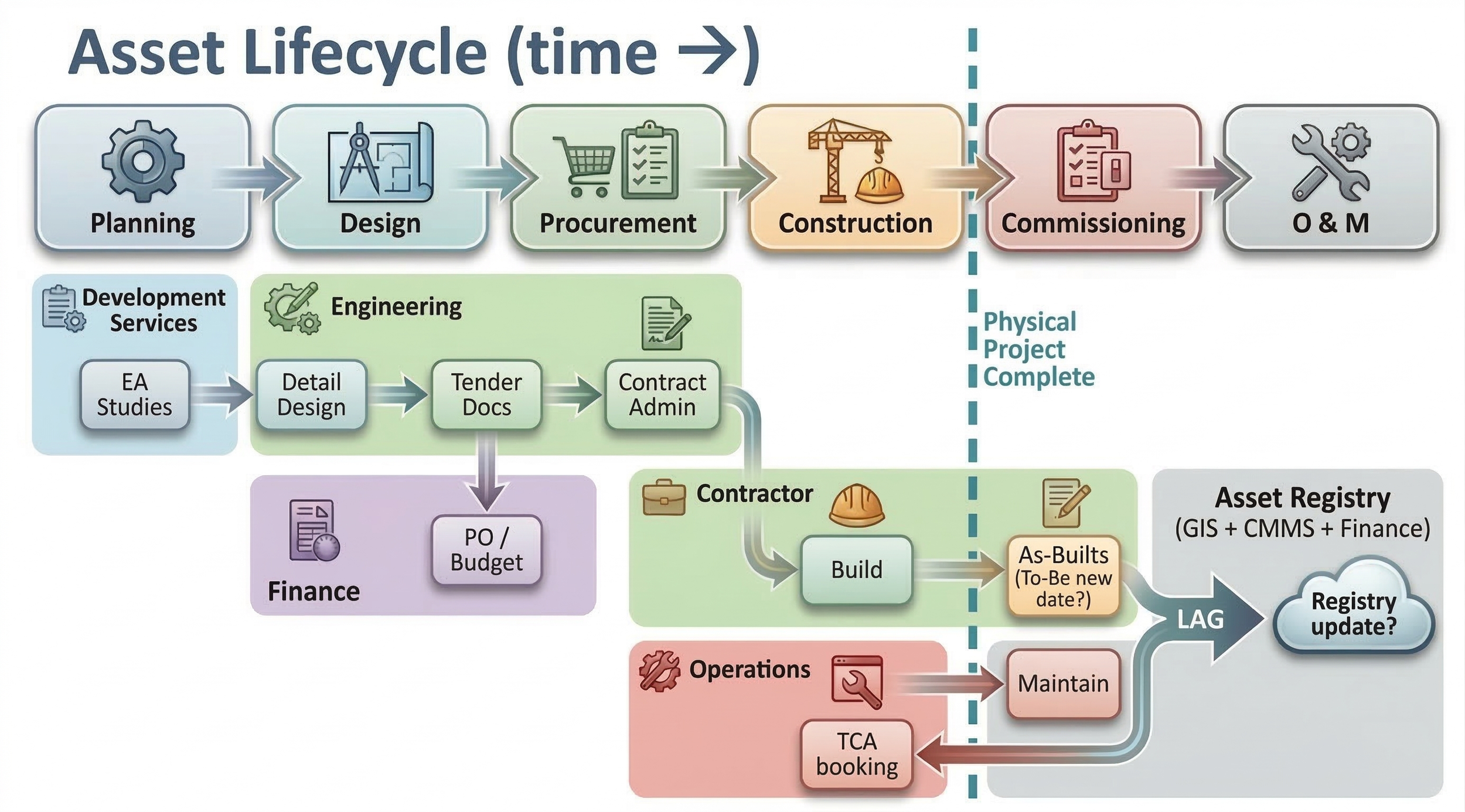
Nobody owns the space between these systems. That is the governance gap.
What Comes Next
Compliance told you what to build. Readiness tells you whether it holds.
The entire lifecycle of an asset needs to function as one coherent chain, from…
idea through design,
construction,
operation,
maintenance,
and replacement
When the chain breaks at any handoff, everything downstream works from approximation. You cannot fund, plan, or manage infrastructure you cannot accurately account for.
The municipalities that will be ready for what comes next are the ones measuring the integrity of that chain today — not waiting for the next mandate to reveal what they missed.
That is what a readiness evaluation measures.
A Roadmap, Not Shelf Document
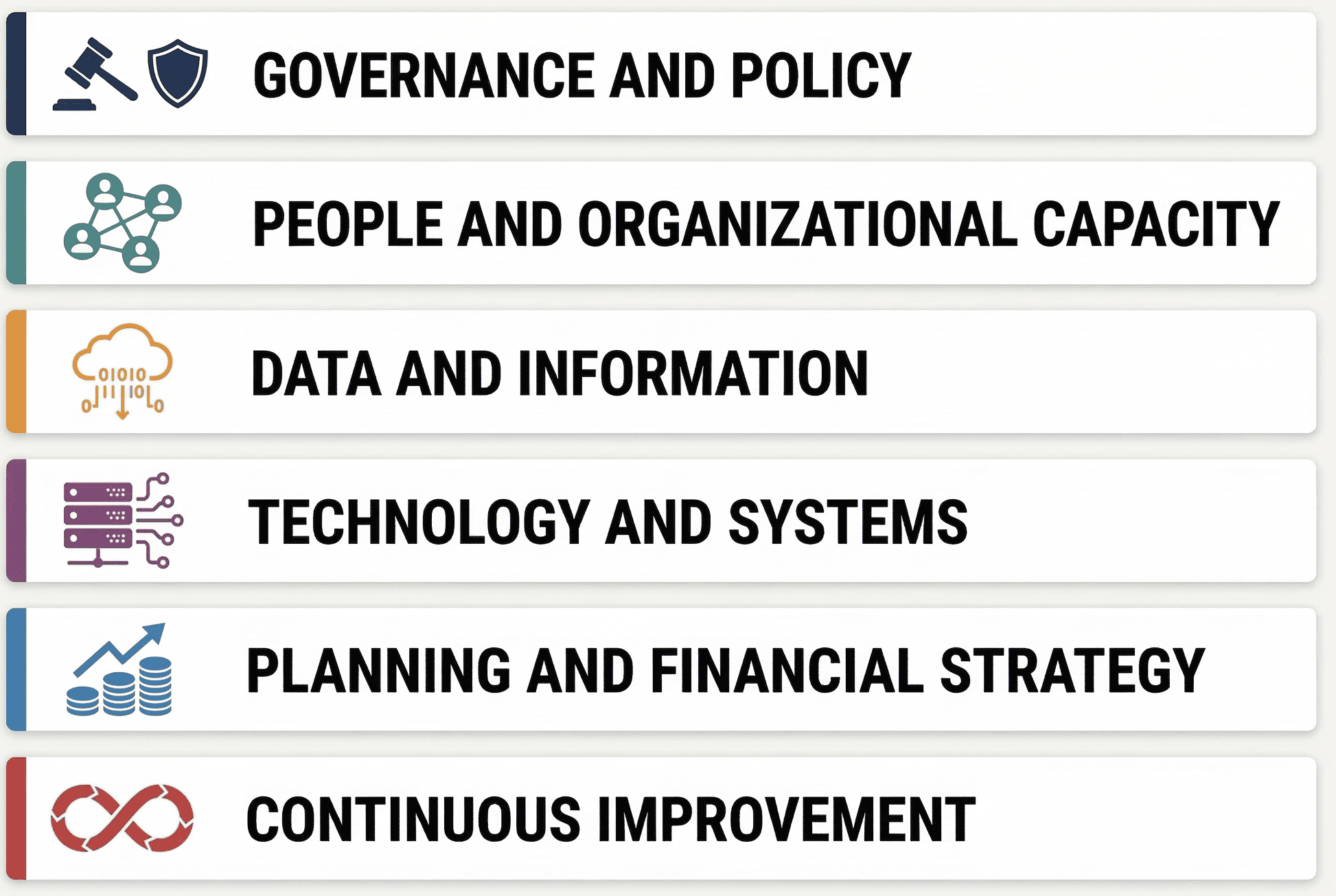
A Stronghill readiness evaluation is not an audit. It is a diagnostic — a clear-eyed look at whether your asset management program and the registry underneath it can meet the demands that are coming next.
This is not a report that sits in a binder. It is the starting point for the next decision your organization makes.
Who’s Behind This
Gary Stronghill, MPA, GISP
IPWEA NAMS Canada Certificate in Asset Management Planning
I didn’t start with a Master’s degree and a suit. I started as a cartographer.
I spent 25 years inside the system — implementing the software, managing the teams, and watching the gap between asset management plans and operational reality grow wider with every compliance cycle.
...What I found was a pattern you can't see from a textbook alone. The reason so many asset management programs underperform isn't usually a technology problem — it's a readiness problem.
I'm not here to give you a polished sales pitch. I'm here to help you understand whether the asset management program your municipality is already investing in can meet the demands that are coming next.

Start a Conversation
The first step is a conversation, not a pitch, not a proposal
A 30-minute discussion about where your municipality stands, what pressures you're facing, and whether a readiness evaluation would be useful.
If it's the right fit, we scope it together. If it's not, you'll walk away with a clearer sense of the questions you should be asking.
Gary Stronghill MPA | GISP | IPWEA NAMS Canada Certificate contact@garystronghill.com
Independent. Software-agnostic. 25 years in municipal infrastructure systems.